
AI-Powered Construction Estimating: Days to Minutes with JobTread
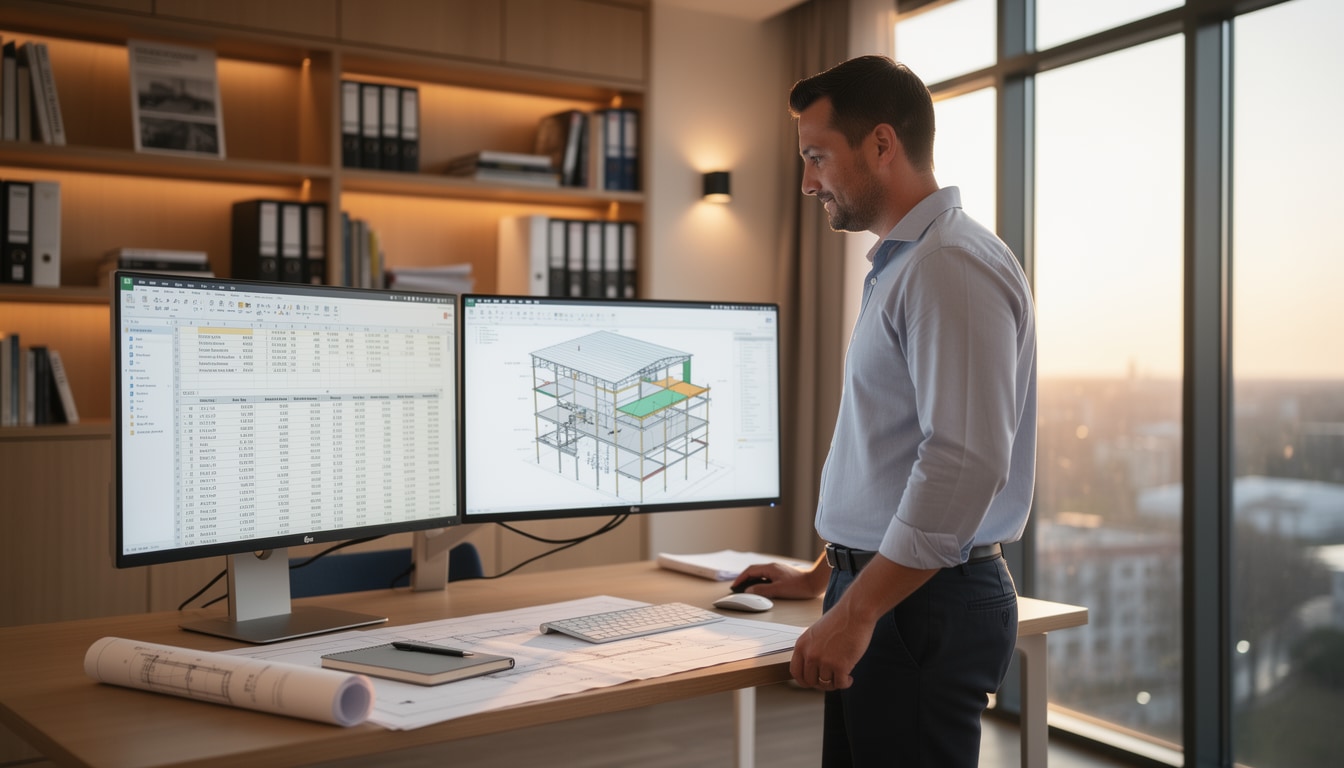
AI-powered construction estimating is redefining how builders compete for deals. I've worked with over 300 builders across residential construction, and I'm watching a clear divide emerge: companies that embrace intelligent estimating are capturing market share while their competitors remain stuck in manual processes.
Here's what's changed. Five years ago, a residential builder needed 3-5 days to turn an estimate. A lead came in Friday morning, and your customer waited until Wednesday for a proposal. Competitors jumped in. Deals died in the inbox. Today, with AI integrated into your estimating workflow, that same estimate takes 45 minutes. The lead gets their number before lunch. You're first. You're professional. You close more deals.
I founded Go First Consulting on a simple principle: construction leaders shouldn't spend their best people's time on work a machine can do better. Estimating became my case study. And what we've documented is striking.
The Speed Problem That's Costing You Revenue
Let's ground this in real numbers.
A mid-sized residential builder we worked with was turning estimates in 4-6 days. They had two dedicated estimators. Each spent roughly 6-8 hours per estimate on material takeoffs, labor calculations, and formatting. They processed about 15 estimates per month. That's roughly 90-120 hours per month spent on manual estimation.
At $75/hour fully loaded cost, that's $6,750 to $9,000 monthly on estimating labor alone.
Now multiply that across a year. We're talking $81,000 to $108,000 annually just to deliver estimates slowly.
But the real cost isn't labor. It's lost deals. When your response time is 4 days and your competitor responds in 4 hours, you lose deals before you ever submit. Industry data suggests that proposal turnaround time directly correlates with close rates. Estimates delivered within 24 hours close at rates 2-3x higher than those delivered after 48 hours.
Go First Consulting has helped builders quantify this leakage. On average, a mid-sized builder (25-35 annual projects) loses $140,000 to $280,000 annually in missed revenue due to slow estimate turnaround alone.
That's where AI-powered estimating changes the game.
How AI + JobTread Cuts Turnaround to Under 45 Minutes
JobTread is construction management software built for residential builders. What makes it different in 2026 is its integration with AI-powered estimating workflows.
Here's how the process works now:
- Lead submits scope (photos, dimensions, specifications)
- AI extracts takeoffs automatically from images and documents
- System cross-references your historical labor rates, material costs, and markup rules
- Estimate generates in real-time with builder's branding and terms
- Estimator reviews for 5-10 minutes (not hours)
- Proposal sends to customer same day, usually within 45 minutes of initial scope submission
This isn't fully autonomous yet. Your estimator still has judgment. They review square footage calculations, flag unusual material requests, adjust line items based on site complexity. But the heavy lifting, the 6-hour data entry and calculation phase, is gone.
One builder we worked with at Go First Consulting reduced estimate turnaround from 5 days to under 90 minutes within 30 days of implementation. Their close rate on estimates jumped from 34% to 47%. In their market, that meant capturing an additional $310,000 in revenue within 90 days.
They didn't need new estimators. They needed different work from the ones they had.
The Real Revenue Impact: Three Levers
When we talk about AI-powered estimating, most people focus on speed. That's the headline. But the actual financial upside comes from three distinct levers.
Lever 1: Increased Proposal Volume When estimates take 45 minutes instead of 5 days, you can handle 3-4x more estimates monthly without hiring. Same team. Same overhead. More proposals.
If your close rate is 35% and you're currently sending 40 estimates monthly, you're winning 14 projects. If the same team now sends 120 estimates (because speed is no longer the constraint), and your close rate stays at 35%, you're winning 42 projects.
On average contract value of $85,000, that's $2.38 million in additional annual revenue from the same team.
Lever 2: Faster Cash Conversion Estimates that turn in 45 minutes win faster. Faster wins mean faster starts. Faster starts mean faster invoicing and faster cash. We've seen builders improve their days sales outstanding (DSO) by 8-12 days simply by winning deals quicker and starting sooner.
On $2.38 million in additional annual revenue, 10 days of faster DSO is roughly $65,000 in improved working capital. That's cash you can reinvest in operations or reduce bank debt.
Lever 3: Reduced Estimation Errors and Change Orders AI systems learn from your historical projects. They adjust for your specific labor productivity, your preferred suppliers, your margin targets. Over time, estimates become more accurate.
One builder reduced change orders from 18% of contract value to 8% of contract value within six months of AI-powered estimating. On $2 million in annual revenue, that's $200,000 in improved profitability.
Total upside from these three levers for a mid-sized builder: $2.38M+ in incremental revenue, $65K in working capital improvement, and $200K in reduced change order impact.
That's real money.
What Go First Consulting Is Seeing in the Field
We work with builders at three levels: those experimenting with AI tools, those in serious implementation, and those fully integrated.
The experimenters treat AI estimating as a curiosity. They upload a few jobs, get surprised by how fast it works, then revert to old habits because "it doesn't feel right."
The implementers commit to the process. They audit the AI output, trust it after 30-40 estimates, and build workflows around faster turnaround. These builders are the ones capturing share.
The fully integrated builders have trained their sales teams to promise 24-hour turnarounds. They've changed how they prospect (more leads, knowing they can respond faster). They've repositioned estimating as a competitive advantage, not a cost center.
I'm watching this shift accelerate. In my experience, builders who move to AI-powered estimating in the next 12 months will have a 24-month competitive advantage over those who wait. After that, it becomes table stakes.
Why Speed Matters More Than You Think
Here's a truth that doesn't get enough attention: speed in estimating is a proxy for professionalism.
When your customer gets a detailed, branded estimate within 45 minutes of requesting one, they don't think "wow, that's fast." They think "this company is organized, professional, and serious about earning my business."
Compare that to a competitor who shows up with an estimate three days later. Same numbers, worse perception.
What You Need to Know About Implementation
Moving to AI-powered estimating requires three things:
-
Systems Integration: JobTread connects to your project management, accounting, and CRM. Data flows seamlessly. If your systems are fragmented, you'll need integration work first. Budget 4-8 weeks for full integration.
-
Historical Data: AI learns from your past projects. You need 12+ months of accurate project data to train the system properly. If your historical records are messy, spend 2-4 weeks cleaning them up. It's worth it.
-
Team Buy-In: Your estimators might worry about automation. They shouldn't. They're moving from data entry to judgment work. Frame it correctly, and you'll see adoption rates above 80% in month one.
Go First Consulting typically guides builders through a 12-week implementation where we audit current processes, integrate systems, validate historical data, and train teams. We measure success by comparing estimate turnaround and close rates before and after.
See our full AI enablement services for details on how we guide this.
The Hidden Benefit: Your Best People Get Better
Here's something I didn't expect when we started work in this space: AI estimating makes your good estimators great.
When your estimators spend 6 hours on data entry, they're exhausted by the time they get to judgment work. They're tired. Their eyes are on the spreadsheet, not the project.
When estimation takes 45 minutes, your estimators have energy for what actually matters: visiting sites, asking clarifying questions, and building relationships with customers.
One estimator we worked with told us: "For the first time in my career, I actually enjoy my job. I'm not a calculator anymore. I'm a consultant." He's now leading a revenue team. The best people stay when the work matters.
Frequently Asked Questions
Q: Does AI estimating reduce quality or accuracy? A: The opposite. AI standardizes your estimating process, pulls from historical data consistently, and eliminates the human errors that come from fatigue or inconsistency. Your estimators review and adjust for site-specific factors. You get consistency plus judgment.
Q: What happens if the AI gets a takeoff wrong? A: Your estimator catches it in the 5-10 minute review phase. AI isn't fully autonomous. It's doing the work that used to take 6 hours in 10 minutes, plus human review. The system learns and improves over time.
Q: How much does AI estimating software cost? A: JobTread's AI-enabled estimation runs $300-800/month depending on usage volume. Implementation and training typically cost $3,000-8,000. For a builder capturing $200K-500K in additional annual revenue from faster turnaround, the ROI is 8-12 weeks.
Q: Will this put my estimators out of work? A: No. Most builders struggle to hire estimators. This makes your estimators more valuable because they're doing higher-level work. You're likely to see your best estimators get promoted into project or operations roles.
Q: How long until AI estimating becomes standard? A: I'd estimate 18-24 months for mid-market adoption, 3-4 years for full industry normalization. Right now, builders using this are winning deals against those who aren't.
The Bottom Line
AI-powered construction estimating isn't coming. It's here. Builders are already using it to capture market share, improve profitability, and free their teams to do real work.
The question isn't whether to adopt AI estimating. It's when.
If you're running a residential construction company and you're still spending $80,000-120,000 annually on manual estimation, you're not being strategic. You're being slow.
Go First Consulting works with builders to assess whether AI-powered estimating makes sense for your operation. We look at your current turnaround times, your close rates, your team capacity, and your integration readiness. Then we map a path to implementation that fits your business.
Visit our AI Operating System page to see how AI integrates across your full business, or check out our results to see how we've helped 312+ builders like you drive measurable impact.
If you're ready to explore this for your business, take our quick assessment to see if we're the right fit to guide your implementation.
Grant Fuellenbach is the founder of Go First Consulting, where he has helped 312+ residential builders drive $5.3M+ in measurable client impact across 7 service lines.