
How do I finish a construction software setup that was never finished?
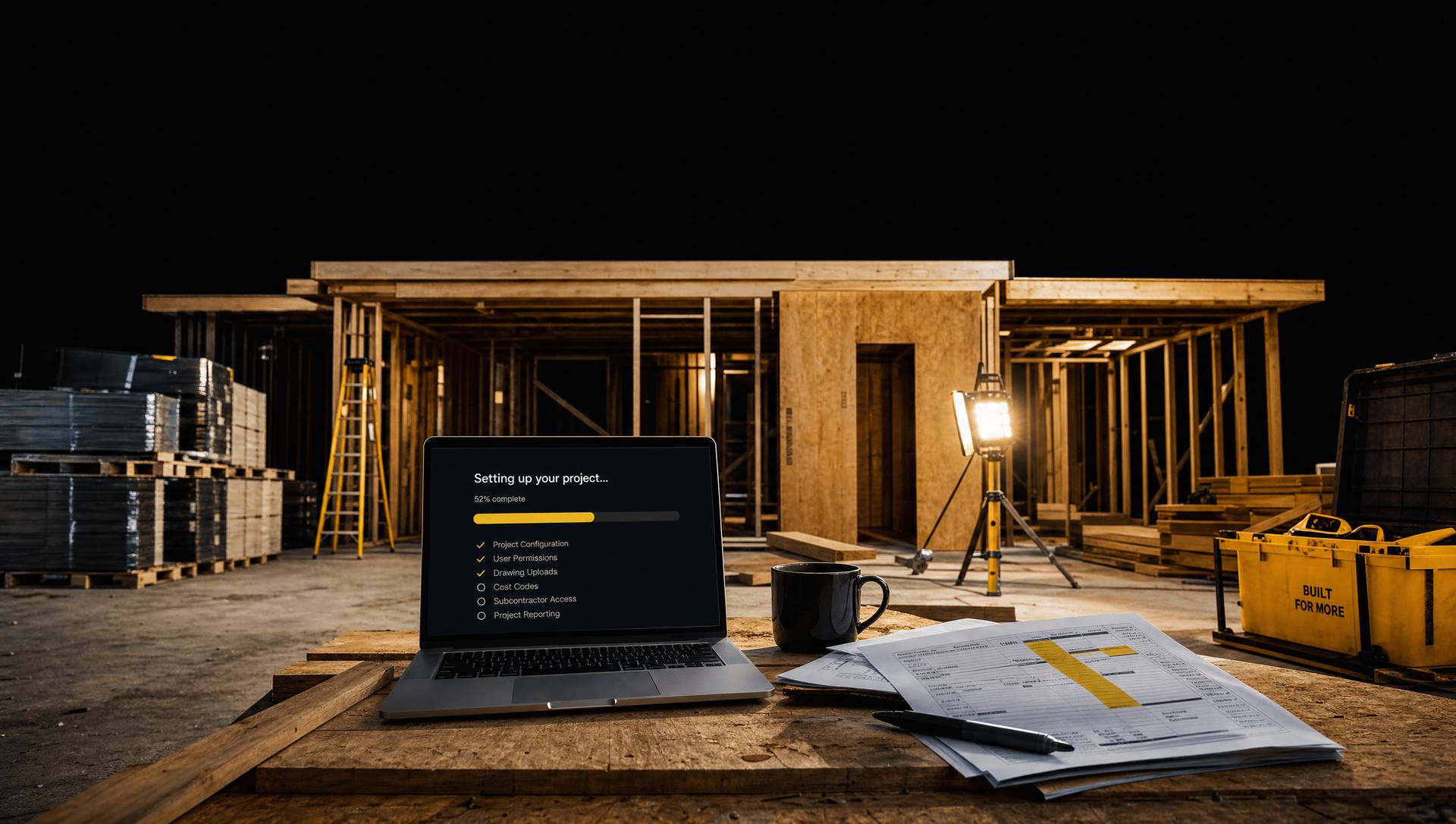
Pick one owner, write down the process before you touch a setting, and block 45 minutes a week until it is done. Most stalled setups are not a software problem. They stalled because the person who started the build-out left or got buried, and nobody took the rest. You do not need a new platform. You need a name on the job and a finish date.
Run the Skill Match assessment. Ten minutes, and you will know which system to finish first.
Table of Contents
- Why do construction software setups stall?
- What does a half-finished setup cost?
- Who should own finishing it?
- What do I finish first?
- How long does it take?
- Should I just switch platforms instead?
- Questions Builders Are Asking
- What's Next
- Sources
Why do construction software setups stall?
Almost always for the same reason. One person did the setup. That person left, or got pulled into production, and nobody picked up the rest.
The build-out never had an owner. It had a volunteer.
Here is the part that keeps it broken. Half-configured software still works. Jobs still run. Invoices still go out. So nobody files a complaint, and the missing half never makes it onto a list.
I saw four versions of this in three weeks of client and prospect calls. Different shops, different platforms, one shape every time.
The most common triggers:
- Staff turnover. The office manager who ran the migration takes another job.
- Season. The build-out starts in January and dies in April when the schedule fills.
- No written process. The easy settings get configured. The settings that require a decision do not.
- A second system starts up alongside it. Now half the shop is in one tool and half is in another.
That last one is the killer. Two half-built systems are worse than one, because now nobody trusts either.
What does a half-finished setup cost?
More than the software. The leak shows up in places nobody connects back to the setup.
Change orders are the clearest one. When the approval path was never configured, approvals happen verbally. Verbal approvals do not bill. Roughly 40% of change orders never get invoiced, and the average remodeler leaks about $2,847 per project in unbilled changes.
A half-built system does not cost you a subscription. It costs you $2,847 at a time, on jobs where nobody notices.
The second cost is the owner. You are already working 70-hour weeks. Every gap in the system routes another decision back through you, because the system cannot make it without you.
The third is money you already spent. Real examples from client work this month, anonymized:
- A shop paying $4,000 a year for a training platform that held zero written SOPs.
- A shop paying a web vendor for exactly one hour of support a month.
- A shop still estimating out of 12 separate spreadsheets that were supposed to become one cost catalog. When we merged them, the labor rates disagreed with each other.
None of those are software failures. Each one is a process nobody wrote down, sitting inside a tool everybody blamed.
Who should own finishing it?
One person. Not a committee, and not "the team."
The owner needs three things:
- A name. Written down, said out loud in a meeting.
- Authority to decide. If they have to ask you what counts as a change order, they are not the owner.
- A standing block on the calendar. 45 minutes a week, same slot, until it is done.
It does not have to be your best builder. It usually should not be. Pick the person who is careful with details and finishes things.
If you are hiring for the seat, that instinct has a name. HireBus built its whole RightSeat assessment around behavioral fit, on the premise that the wrong person in the right seat still fails. That applies to a build-out exactly like it applies to a crew.
What if nobody has time? Then the build-out does not get finished, and you keep paying for it either way. Forty-five minutes a week is one truck ride. Compare it to the $65K operations manager you cannot afford yet.
What do I finish first?
Not the feature that looks best in a demo. The one that touches money.
Work in this order:
- The cost catalog. Estimating is where margin is won or lost. If your rates live in spreadsheets, nothing downstream can be trusted.
- The change-order path. Who requests, who approves, how it gets written down before work starts.
- The job-to-production handoff. When does a job leave estimating, and who owns it after.
- Selections and client approvals. The workflow that generates the most emails.
- Daily logs and field capture. Last, because it is the easiest to adopt once the rest works.
Before you configure any of it, write the process on one page. Who does what, in what order, who approves.
That page takes 45 minutes. The configuration takes an hour once the decision is made. It takes six months when it has not been.
The data outlives the software
Your cost catalog, your labor rates, and your job history are the asset. The platform is just what reads them.
That premise is the whole reason the real estate data category exists. Kevin Shtofman, who leads innovation at Cherre, works on exactly that problem at portfolio scale. Teams like Allie DeMond's at Wrench.AI are building on the same idea.
The lesson for a $3M builder is the same as the lesson for a REIT. Clean your data first. Every tool you buy after that gets better. Every tool you buy before it inherits the mess.
Not sure which of your six core systems is the real bottleneck? The Skill Match assessment takes ten minutes and names it.
How long does it take?
For a shop that already owns the platform and is partway in, plan on six to ten weeks at 45 minutes a week. Add one longer session up front to write the processes.
That is a working estimate from how these go, not a guarantee. Two things move it:
- How bad the data is. Merging 12 spreadsheets with disagreeing labor rates takes longer than merging two clean ones.
- Whether the crew adopts it. A system only the owner uses is not finished. It is a hobby.
Do not try to finish all six systems at once. Finish one. Let the team feel it work. Then start the next.
Should I just switch platforms instead?
Usually no.
Switching feels like progress because the new demo is clean and the salesperson is answering your questions. But you will get halfway through the new one too, for the same reason you got halfway through this one.
Switch only when one of these is true:
- The platform genuinely cannot do a thing your business requires. Not "does it awkwardly." Cannot.
- You are already fully off the old one and the migration is done.
- The vendor is gone, or support has stopped.
Everything else is a build-out problem wearing a software costume.
On vendors, be honest about what you are getting. Audit every subscription in the stack and mark the ones nobody opened this month. There is a real difference between a partner doing the work and a line item. Agencies like Contractor Growth Network, run by Logan Shinholser, have made the Inc. 5000 three years running on construction clients. Compare that to paying someone for one hour a month and calling it support.
Questions Builders Are Asking
How do I know if our construction software is only half set up? Look for work happening outside the platform. If estimating runs in spreadsheets, approvals happen by text, or your subs never log in, the build-out stopped early. Another tell: nobody can say who owns the setup.
Can I finish the setup without hiring anyone? Yes, in most shops under $15M. The bottleneck is almost never headcount. It is that nobody has been given the job and a recurring block of time. Name an owner, give them 45 minutes a week, and check it every Friday.
What if the person who set it up already left and left no notes? Start from the process, not the software. Write down how the work flows today, one page per system. Then open the platform and make it match. Reverse-engineering someone else's half-finished settings takes longer than deciding fresh.
Do I need my whole crew to use it, or just the office? The office first, the field second. Finish estimating, change orders, and the production handoff before you ask a framer to log anything. A crew asked to adopt a system the office does not trust will not adopt it.
Should I pay the software vendor for implementation help? It depends on what they configure versus what they train. Vendor implementation is good at turning on features and poor at deciding your process, because they do not know your business. Write the process yourself, then let them configure against it.
How much of my cost catalog needs to be built before the software is usable? Enough to price your three most common job types accurately. You do not need every line item. Start with the assemblies you sell every week, confirm the labor rates agree across them, and add the rest as jobs come up.
What's Next
Finish one system, not six.
Pick the owner this week. Write one page of process. Book the 45 minutes.
If you are not sure which system to start with, take the Skill Match assessment. Ten minutes, and it names the bottleneck for you.
Then go finish it.
Worth following: Builder Brigade publishes plain-language homebuilding education that is worth a look if you are the one explaining the process to a client.
Sources
- Day.ai CRM scan of client and prospect conversations, July 16 to August 5, 2026. Four separate conversations named a partially completed platform build-out. All client references are anonymized composites.
- Approved pain and result figures from GO First's internal proof-and-personas reference. Used here: $2,847 per project in unbilled changes, 40% of change orders never invoiced, 70-hour weeks, the $65K operations manager.
- HireBus RightSeat assessment, behavioral hiring assessment for home-services businesses.
- Kevin Shtofman joins Cherre as Head of Innovation, Business Wire, January 2023.
- Contractor Growth Network, Inc. 5000 honoree 2022, 2023, and 2024.
- Wrench.AI
- Builder Brigade
By Grant Fuellenbach. Published August 6, 2026. Last updated August 6, 2026.